
“I say, Charles, are you still with us?”
“What’s that? Of course I am,” said Charles Bryant.
“I thought we’d lost you again,” said Nelson Peters before emptying his glass of wine.
“You have not ‘lost me again’ as you put it.” Bryant had removed his glasses to clean them and, truth be told, to provide an excuse for looking away from the inquisition of his dinner companions.
“Well then, is there any truth to this rumor?”
The lens shifted in its frame. Bryant loosened his grip, having no time or patience to obtain a new pair.
“And what, pray tell, would this ‘rumor’ be?”
“Ah you did wander off—but never mind,” said Peters, with a knowing glance at the others around the table. “Word is you are leaving town for a spell?”
“Yes, Nelson. This is true,” said Bryant. “You and the rest of this sad crew will have to make do with an empty chair here at the club, one less person beneath a reading lamp at the Athenaeum—at least for October and November.”
“Do tell,” said Phillip Tillinghast, sitting next to Bryant.
“Nothing too dramatic. I’ve rented a house in the Penacook Valley—Burford to be exact. I have no interest in enduring the racket as they build the second coming of Grand Central Station in front my house.”
“It’s a streetcar line, Charles,” said another. “They did the same near my parents’, and the disruption was minimal.”
“Edward, I’ll note that you said ‘near’ and not directly in front. Let the record also reflect, your parents were in Bar Harbor the entire time and you lived here at the club.”
“But not because of the construction—mother and father insist on taking all the staff with them.”
“I rest my case,” said Bryant, straightening his jacket in a clear indication he would soon rise to leave.
“We are merely joking,” said Tillinghast. “You could use the time away.”
Bryant flashed a stare that, he feared, betrayed alarm.
“We all could use some time in the countryside, Charles. Couldn’t we?”
Bryant rested his hands on the back of the chair. “If that is true and any of you are looking for an escape from the city. I will have room for a guest or two…for short stays.”
This invitation was an easy one to make: Bryant knew no one would take up his offer.
# # #
From Charles Bryant’s seat on the train, the Penacook Valley was resplendent in the early autumn sun, displaying a wild celebration of color before cold and quiet took hold and the landscape would become an unrelieved stretch of white beneath ceaseless gray skies scarred by the black branches of the slumbering trees.
Bryant’s train arrived within minutes of its scheduled time. The leasing agent was at the station to greet him. They walked together to the house that would be his home for the next few months.
Burford was exactly what Bryant had sought. From the train, he had admired the farms, their fields harvested and plowed for the winter. As the train neared the station, houses were closer together, until nearly side-by-side. Thanks to the blessings of its geography, a village had developed into a robust town over time. The bridge across the Penacook, enlarged several times, accommodated those traveling beyond the valley to the west as well as those who sought a gateway to the valley and all of New England. With the development of rail travel, Burford was the logical choice for an exchange for lines to the east and Maine as well as west for the Hudson valley.
In the face of this transient bustle, the town maintained a steadfast reserve, its residents going about their business, paying no attention to the comings and goings of strangers, and seeking to draw little attention from neighbors.
While Bryant had told his lunch companions he had rented the house for October and November, he had already exercised his option to renew to the end of the year. What he would offer as a reason for extending his absence when the roadwork had been completed by then, he left to worry about another day. He had, after all, been amused at the way his desire to escape the disruptive roadwork was so easily accepted as the reason for his escape, his retreat.
Bryant was confident his parents knew better, while having the tact to never question his stated reason. Or did they simply fear the answer he might give?
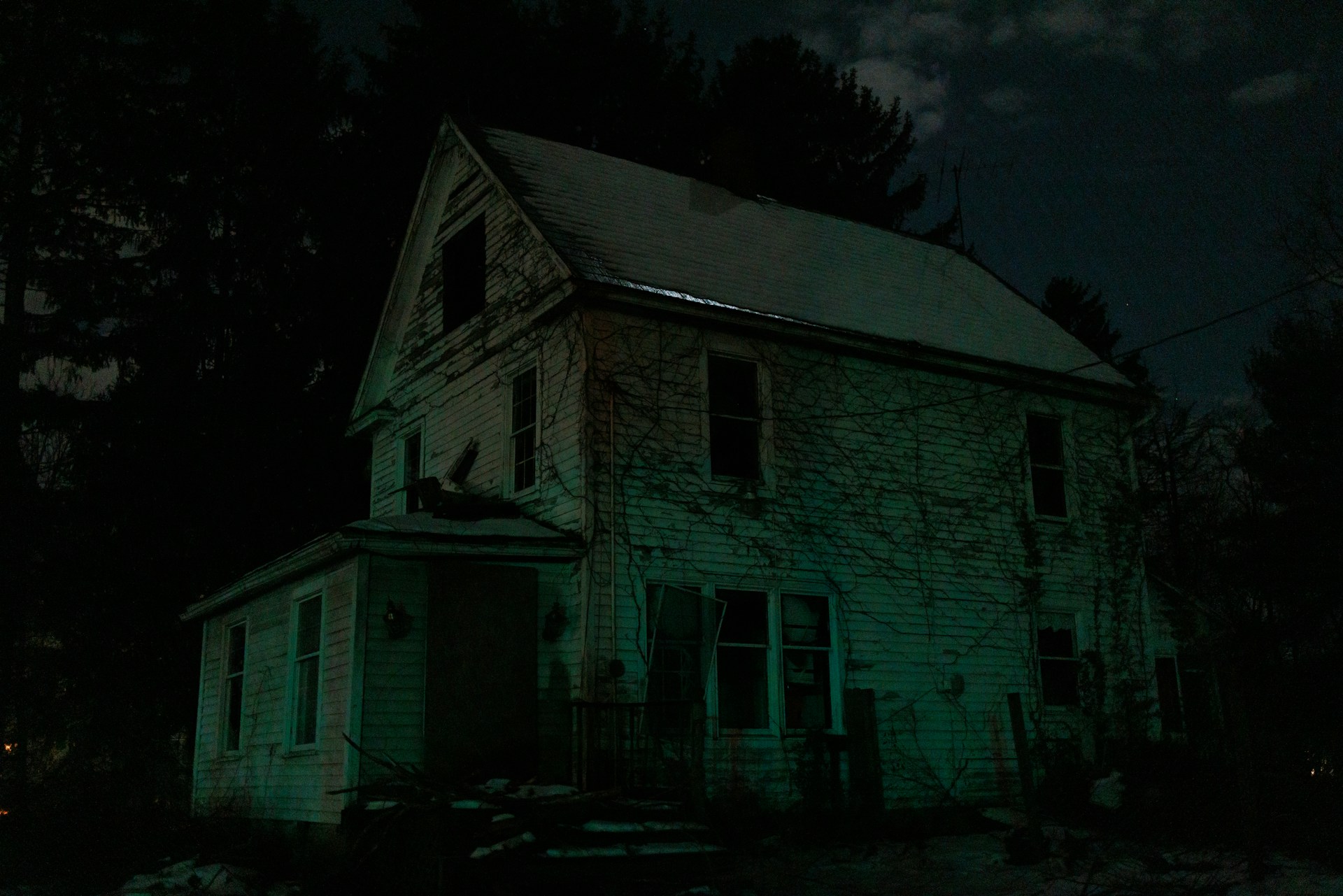
The house lay down a tree-lined street a few minutes’ walk from the center of town. Thanks to its crisp, white clapboards, the house shimmered out of the shade of the giant elm. Behind the house, a dense forest.
Bryant was introduced to the elderly couple, Mr. and Mrs. Winston, who would tend to his needs and the care of the house. Mrs. Winston had unpacked his trunks and set out everything, she hoped, as he wished. She handed him a menu for the week’s meals, having made choices she trusted he would be acceptable. Bryant assured her his demands were simple and, to her even greater relief, that he would do no entertaining during his stay.
After a brief tour, Bryant exited the French doors of the library to enter the garden behind the house. A table and chairs sat on a flagstone terrace in the shade of the giant elm, separated by a low stone wall from the lawn that stretched about fifty yards, ending in abundant flowerbeds. Behind this, a line of flowering trees stood before a dense forest. No wall or fence marked the end of the property and the woods beyond.
Bryant walked the perimeter of the lawn. The leasing agent joined him.
“What brings you to Burford for this extended stay, Mr. Bryant? Retiring from business?”
“No, not retiring—though my father might welcome that,” he said.
Thanks to working within the accommodating conditions of his father’s firm, Bryant largely evaded the consequences he would have otherwise faced for too many deadlines missed, assignments forgotten, appointments unkept. Bryant knew his mental absences would never be tolerated outside a small family firm. He had become an embarrassment to his father. The “war hero” son was no longer proudly brought to lunch at his father’s club.
At the far end of the lawn, Bryant stopped where a line of flagstones, obscured beneath dense overgrowth, offered a route through the flowerbeds.
“A pathway into the woods?”
“I suppose it is—was,” said the leasing agent. “I am sure no one has taken that path for quite some time.”
“I shall get Mr. Winston to open this up,” said Bryant.
“Oh, there’s better places to go exploring.”
“But this forest is right out my back door.”
The leasing agent said nothing, but his purposefully blank expression aroused Bryant’s curiosity. Bryant followed but paid little attention to the enthusiastic description of “superior trails” through “better forests.”
In the week that followed, Bryant reminded Mr. Winston every day to clear the old path into the forest. He never did.
# # #
Mary Robinson was alone. Nothing new in that.
Today she was the day she would finally take a walk into the woods. If everyone in town shunned her, why should she listen to their foolish warnings? Just one more way to show she didn’t care what they thought of her.
The first thing she heard was the high-pitched squeals of children at play. Feeling warm, she removed her gloves, twisting them in her hands. She kept walking toward the noise.
They never listened, those two, thought Mary Robinson. No matter how many times she warned them, threatened to tell their mother.
They just carried on. They did it on purpose. To annoy her. She knew it.
And what happened that day was exactly what she warned them about. They should have listened to her. It’s nothing more than what they deserved.
Things happen so quickly. Accidents, really.
She’d only stepped away for a minute, maybe two. It’s not every day Mary Robinson could boast the newest hat in town. She had every right to show it off. She had done her job—warned them a thousand times. Nothing would have been different if she had been there.
She had stifled her scream when she went back inside the house. Glancing out the front door, Alice and Ellen Thompson were walking away—no doubt saying nasty things about her. If Mary ran for help now, it would be obvious this had happened when she had left the boys alone.
She would have to wait. Five minutes, ten?
Those miserable boys, their eyes open, stared up at her.
“Dr. Jackson, I was watching them like I always do. I’ve warned them a hundred times, I have.”
Mary stepped into the clearing in the woods. There was that handsome two-story house. One of her gloves fell to the ground.
Once again, Mary opened the door just in time to see two boys fall from the top of the stairs.
Why did their damn eyes always have to be open?
# # #
Adapting to village life proved easier than Bryant had imagined.
Mornings were spent reading, taking advantage of the library in the house. Bryant enjoyed surrendering to the interests and tastes of another man. In the afternoon he explored his new surroundings. He was soon familiar with most of the streets in the village, had visited all the shops in the center of the town.
Bryant suspected the regulars in the park were beginning to recognize him and wondering what a man in the prime of life was doing here with no evident occupation or obligations.
Probing Mrs. Winston for town gossip yielded nothing that satisfied Bryant. “Who’s the handsome new man in town?” “Will family be joining him?” No matter how much Mrs. Winston insisted, this is not what Bryant imagined passed through town. By now, he was used to people talking about him, familiar with being the subject of nasty gossip. He assumed Mrs. Winston was too polite to share the truth. He decided to be grateful for that.
Bryant explored the countryside. He purchased a small sketchbook and filled it with drawings of fallen trees, meandering streams, young mothers pushing prams in the autumnal light of the park. He wrote to his sister in Boston asking her to send a package of art supplies—sketch pads, pencils, charcoal, brushes, tubes of watercolor paint, paper—an assignment she was overjoyed to perform, seeing in the letter hope for the return of the brother she thought was lost forever.
Bryant was unpacking the art supplies from Boston when Mrs. Winston delivered his mid-morning tea. His sister had sent everything he asked for, along with a few thoughtful additions—white and red charcoal, loose sheets of blue and terra cotta paper, and three books of poetry—Longfellow, Whitman, and Poe.
“Mrs. Winston, look at this bounty from my sister, Helen.”
“Oh, this should keep you busy Mr. Bryant. You’ve got a real talent, you have.”
“I have not tried watercolor in years, not since—well, it has been ten years now,” said Bryant. “Nothing better than a still life to exercise my dormant painting muscles, Mrs. Winston. Before this storm headed our way makes me a prisoner, I’ll gather some things from the woods for a still life or two.”
“I could bring you things from the kitchen—fruit, a jar of honey, preserves?”
“You and Mr. Winston are determined to keep me out of those woods.”
Mrs. Winston began a defensive denial. Bryant cut her off.
Mrs. Winston watched Bryant cross the lawn and shuffle through the overgrowth Mr. Winston would never trim back.
# # #
The woods were darker than Bryant had expected.
Sun poked through breaks in the clouds from the oncoming storm, but little of that light filtered through the dense canopy above.
Bryant added a pinecone, a wind-tossed bird’s nest, and more to the leather bag carried over his shoulder. After bending to pick up a piece of bark, Bryant realized he had been so focused on surveying the ground he had paid no attention to the route he had taken.
Was home still behind him? Or did it now lie to his left?
His eyes darted around the woods. “No one has taken that path in quite some time.” Bryant dug his fingers into the palms of his hands. It wasn’t just the Winstons. Snippets of overheard conversations came back to him. “Never been the same since he took that walk in those woods.” This is just a typical New England woods, he told himself. Whatever lore attached to the place was nothing but local superstition.
He walked in one direction. Stopped. Changed directions and then changed back.
The wind rose and began to sound like breathing—hoarse, strained, desperate. The trees swayed in unsettling unison. Bryant shook his head, trying to shake oncoming dizziness. He struggled to hold his balance.
Bryant failed to notice a low-hanging branch until it was too late. Its sharp point scratched his face. He wiped his cheek, staining his handkerchief with a smear of blood.
A muffled rustle in the dry thicket behind him awakened dormant habits from his years in uniform. Biting his lip, Bryant crouched. This had been his way of feeling more attuned to what surrounded him. He gently closed his eyes. He concentrated and slowed his racing breath.
The trick was to hear what did not belong, to listen past the straining whine of the wind-bent trees. Time slowed. Bryant picked up new sounds. His eyes flashed open, looking for the flickering betrayal of movement.
It came from a break in the dense growth just ahead. A single glove lay on the ground, twisted tightly. So, others do dare to walk here.
Bryant stepped into the clearing. The surrounding forest darkened.
Bryant approached the crumbling brick foundation of a house that would never be built.
And then, in a flash of terrifying clarity, an agonizing vision knocked Bryant to his knees. His head whipped back as if he had been slapped.
He no longer stood in dense New England woods. All that was gone, replaced with farmland—scarred and burned to death. Bryant stood before a farmhouse, its white clapboards dulled by drifting smoke and dust kicked up from a dirt road. A mother and three young children, expelled from their own home, sat close together on the low porch.
The front door was open.
A figure stepped into the center hall. A lone woman.
I know what’s next. I know what’s coming, thought Bryant.
She’ll come to the door. She’ll wave for me to come in, wait, and then walk away. Next, a man will emerge from the back room and step outside to deliver news I refused to hear.
Bryant stood. He turned and ran.
Again.
# # #
“He didn’t look himself when he came back. I’m not talking about him being all sweaty and dirty, not that. No. He looked different I tell you. That confidence he has, that easygoing way of his, all of that was gone. I knew, right away what had happened, and he knew I knew. He looked at me like he wished he hadn’t seen whatever it is he saw, like he wished he had listened to me, to you.”
“He’ll stay away now—if he knows what’s good for him,” said Mr. Winston.
# # #
“Will you be taking one of your long walks today, Mr. Bryant?” Mrs. Winston asked as she cleared the breakfast table, barely suppressing a disapproving look at how little Bryant had eaten. One triangle of toast, if that, was not enough for grown man. The toast, and butter, and jam, and honey she loaded onto her tray would be happily consumed by Mr. Winston in a few hours.
“I think I’ll stay home. I may have been over doing things a bit lately.”
“Sounds like a good idea, sir. You came to rest, and it’s rest you should get, if you ask me.”
Neither Bryant nor Mrs. Winston made any reference to the events of the day before.
Reading in the garden proved impossible. Bryant could not keep his mind from wandering down the lawn, along the overgrown path, through the woods, and into the clearing.
He moved indoors to sketch an arrangement of fruit and cut flowers—eye, hand, and mind focused on what was directly in front of him. It worked. For a while.
Had he really seen what he thought he had? Impossible. He knew his wounded mind could imagine this scene. But the day before had been different. It did not have the feel of some waking nightmare, of memory stirred by some sensory trigger—the rot of a steamy day, the stink of smoke in the air, the sight of blood against flesh. No. This had been different. Very different.
By the time Mrs. Winston delivered tea and a plate of fresh baked cookies, the floor around Bryant was littered with abandoned drawings, crumpled and torn.
“Looks like you could do with a break,” said Mrs. Winston. “Come sit over here, sir, and have a rest. No need to frustrate yourself. Not anyone making you draw that scene, after all. I’ll clean this up for you.”
Bryant finished his tea and told Mrs. Winston he was going out for a short walk. She was unable to hide her look of alarm. Without acknowledging her reaction, Bryant added he would be walking around town and visiting the library.
There was a slight chill in the air, but it was weeks from true cold. While far from crowded, the streets, walkways, and park were busy. Bryant recognized a few faces, familiar by now. Two young mothers pushing prams approached. Bryant had given them sketches he had made of them sharing stories of motherhood on a park bench. He paused, tipped his hat. They nodded and kept walking. Of course they rushed by, Bryant mused. How must he appear to them?
At the general store that doubled as the local post office, Bryant collected his mail and purchased writing paper and envelopes.
“I trust everything in your package the other day arrived safe and sound, Mr. Bryant?”
“Art supplies from my sister in Boston,” Bryant replied. “Going to try my hand at painting a landscape or still life.”
“We’ve got some lovely scenery in the valley.”
An older man, rail thin, dressed in black, approached the counter.
“I did some collecting in the woods behind the house the other day,” Bryant said. This earned, from the clerk, a slight tilt of his head.
“I should be going and let your other customers—” Bryant stopped. The rail-thin man was gone. “Well, anyway, thank you and have a good day.”
When Bryant stepped outside, the rail-thin man was standing by a streetlamp one door down.
Bryant cut through the park. The water in the fountain sparkled in the autumn sun. It would soon be shut off for the winter. In time, the basin would fill with snow. No children would play in the fountain again until spring. Those who had stood on tiptoe to reach the water would be tall enough to splash at will the following spring and summer. Others would come to shun this once-loved childish play and pleasure.
“You’ve seen it, too. I can tell.”
The rail-thin man sat at the other end of the bench. He did not look at Bryant. His voice was clear, firm, in contrast to his frail frame. He offered no nod, or smile, or offhand greeting.
“Excuse me?” said Bryant, turning sharply.
“In the woods. That house,” the rail-thin man made no effort to hide his impatience. “What did you see?”
“I’m sorry, I’m afraid I don’t under—” Bryant, crumpled his gloves.
“Alright, go ahead, deny it, but you know I’m telling the truth. You’ve seen it and you’re gonna go on seeing it—”
“If you know what it is, then you don’t need me to tell you.”
“So, you don’t understand what’s going on, do you?” Was that surprise, frustration, or—worse—pity, in his voice.
“I understand you are harassing me, and I do not intend to endure this any longer.” Bryant picked up the mail on the bench beside him and began to walk away.
“You’re gonna go back. And you know it,” called out the rail-thin man.
# # #
Dan Vernon had heard the stories. Stay away from those woods.
But now that he was here, he could not resist entering the lonely house he had found. Once he stepped through the door, however, he was standing not in a newly discovered house, but back in an all-too-familiar stable.
And there was that damned unbolted lock.
His throat ached as he swallowed hard, knowing he would soon witness the horror he had refused to imagine all these years.
There was Little Amy, her mother having tempted Dan away. No one was there to stop her. She opened the gate and stepped in.
Next came the wild alarm of an untamed horse.
How long would this go on? But there was only one short scream.
And then, from Amy, silence, as the horse unleashed its fury.
# # #
When a storm moves into the Penacook Valley and settles between the hills and mountains, residents surrender to days and nights of wind and rain. At night, always at night, there is the plaintive cry of trees falling heavily as the rain-soaked earth beneath them gives way. Shopkeepers dutifully open their stores, but no one comes. Their windows shimmer as each gust of wind rattles their rain-streaked glass.
Bryant lay awake.
It wasn’t the wind or rain against his windows. He would have welcomed that keeping him awake. It was that clearing in woods. One moment, the brick foundation of an unfinished house, long forgotten. A home that was never meant to be. And then, in an instant, everything changed, decaying ruin replaced with savage memory. Years and miles erased.
And then there was that rail-thin man.
“You’ve seen it, too. I can tell.”
What did he mean? Why did he ask what Bryant had seen? He said Bryant would go back. This was not conjecture or hazy prophecy. It had been stated as simple fact. And Bryant knew the rail-thin man was right.
Bryant closed his eyes in surrender, got out of bed, dressed, crept down the stairs, and went back to the woods.
The rain-drenched ferns soaked his pants. His boots sank into the muddy earth, seeping through the leather. The air was deeply scented with fresh, green pine, and—at his feet—fallen needles, leaves, twigs, pinecones.
Bryant froze at the first hint of movement. Moonlight shone through breaks in the clouds.
Light glinted off what remained of the shine on the soldier’s buckle, a white shirt billowed out of an open blue flannel jacket, the buttoned shoulder strap holding a canteen in place. This man staggering toward Bryant was not alone. Beside him, a man clutched what remained of his right arm. Behind them, one more, two more. They passed Bryant without a word. He recognized the hopeless tread of those who had stared into the face of death and now carried the curse of having survived.
Bryant continued toward the house in the clearing.
Just as he knew she would, the woman appeared in the hallway and urged him to approach. This time, Bryant took one step forward. Then another.
He was dizzy. With each passing second, the house became less of a spectral image and more real.
Bryant stood at the edge of the porch, waiting for the doctor.
At the far end of the hall, a door opened. Light spilled out. A figured stepped into the hallway. He was not wearing white shirt sleeves rolled above his elbows. He did not wipe blood from his hands. He did not walk with the resigned exhaustion of another failed attempt to save a life.
Bryant stepped onto the porch. At the doorway, he stared into the hallway. No light shined on the approaching figure.
“Nathaniel, is that you?” Bryant’s throat was dry. His voice no more than a gentle breath.
The figure stepped into the light from the windows in the front room.
“My god.” Bryant shuddered, stepped backwards.
The man—disfigured, broken, bloody open wounds, bone tearing through flesh, a dark hole where an eye should have been—stumbled toward Bryant who fell backwards and onto ground.
He pushed himself away from the house, boots pushing into wet ground, frantically crawling backwards.
The bloody specter came no further than the open door.
Bryant buried his face in his hands. When he looked up, the doctor approached.
Bryant ran.
# # #
“Look at the mess of these clothes,” said Mrs. Winston. “He’s been back to the woods, I tell you.”
“Then he’s a damn fool and he deserves what he’s got coming to him,” said her husband.
“No man deserves that.”
“Maybe this one does.”
# # #
When he stepped through the front door of the house, Roger Slater did not enter the hall or the first-floor parlor. He wasn’t even in the odd little house he had discovered in the clearing.
Roger Slater knew exactly where he was.
And, worse, when.
There it was, just like he remembered, the heavy, unsteady tread upon the stairs. The labored, nasal breathing he and his sister Alice openly mocked. With each step, their father came closer to that interminable moment at the top of the stairs. Roger’s bedside light was off. Alice’s would also be dark. No light to escape through the crack beneath the door. Nothing to call attention to their existence.
The familiar, wavering creek of his father reaching the top. Instinctively, after all these years, Roger held his breath.
His hearing was never more acute than at this moment. Within one step he could tell if his father was off to pass out in his own bed, or not. If he turned right, toward Roger’s room, would it be a simple check, an attempt to act out parental responsibility lost long ago in the haze of whiskey.
It wouldn’t be that. Roger knew what moment he was reliving. Some time that spring—around the time Mrs. Daniels first told Alice she should now be looking at the women’s dresses in her shop—their father had started turning left at the top of the stairs.
Soon the door to his sister’s room would open and close.
Roger Slater’s fist was clenched tight. In his hand, just as it had been that night, the evidence of a broken promise: the fishing line he was supposed to have strung low across the top step.
He had opened his door. He had even inched down the hall, one eye on his father downstairs silhouetted against the fire. But he retreated. He went into his room and closed the door.
Alice screamed out that night like never before.
She screamed for Roger, but he did not come.
The next morning, he snuck out of his room. “Tonight. I promise, tonight,” he’d tell Alice. Alice would understand. She’d forgive him, of course she would.
The blood-stained bed sheet was tied tight around the rafter. A torn and bloody nightgown was laid out neatly on the bed.
Alice had changed into a clean, white gown. Death would be on her terms.
Roger Slater would never walk through these woods again.
# # #
The weather cleared. The sun shone. The time of year when one says, “The days are short,” but not yet, “The nights are long.” The annual autumnal idyll, nature’s final open-armed welcome before the unforgiving cold and dark of winter.
Bryant walked home through the park.
The walks were strewn with leaves, by now all turned to brown. The grass had stopped growing for the season. The gas lamps along the walkways would soon be lit, their crisscrossing lines of light revealing the designer’s hand in the graceful arcs and intersecting paths that guided people through the park. The fountain, turned off and drained. The benches that circled the fountain, full during spring and summer, sat empty in the dimming light. Bryant sat to enjoy the tranquil scene.
“You can’t keep hiding.” It was the rail-thin man, a hat shading his face.
“Who are you?” Bryant pleaded.
“Does that matter, really?”
Bryant raised his arms, beckoning an explanation in the face of his confusion.
“You need to go back,” said the rail-thin man.
“I can’t. I won’t,” said Bryant.
“How many years has it been, ten? And you are still refusing, unable, to enter that damn farmhouse. Have you really, fully, experienced any day since then?”
“How do you know all of this?” Bryant tried to affect some degree of anger, but the quiver in his voice betrayed the emotions that swelled within.
“You don’t understand, do you? It’s not about going back. It’s about moving forward. Go.”
The rail-thin man walked away and, before he reached the far side of the park, he was gone.
# # #
Elizabeth King had been warned. Everyone said to never walk this way.
Sunshine slipped through the trees overhead, falling along the ground, playing across her face.
Ahead, through the trees, a house as familiar to her as her own. She had been there that very morning. But here in the woods it did not look like it had this morning. The shutters had not been barn red for years, not since Elizabeth and Rosemary Fremont had been just older than children.
Elizabeth stepped onto the porch and peered through the window.
Impossible. Everything was just as it had been years before.
A figure entered the front room. Elizabeth gasped upon recognizing her younger self. She held an envelope.
Elizabeth shut her eyes in disbelief, but then surrendered to curiosity and resumed watching, a satisfied smile forming as she thought about what she would see.
Young Elizabeth pulled out the letter meant for Rosemary. Ben Jeffries had never written to Elizabeth like this. No one had.
And now, with the passing of time, she knew no one ever would.
After a quick glance to confirm she was alone, Elizabeth dropped the letter into the fire, grabbed the poker, and shoved it deep between two flaming logs.
Ben’s letter would forever go unanswered. There would be no midnight rendezvous. No lovers’ elopement.
In two days, Ben Jeffries—broken-hearted, Elizabeth consoled herself—would be gone, and Rosemary Fremont would forever depend upon the tender sympathy of her one true friend.
“Wouldn’t change a thing,” Elizabeth said to herself as she left the woods.
# # #
Dry leaves crumpled beneath Bryant’s feet. Stray twigs snapped under the heavy tread of his boots.
He was returning to the house in the woods. The rail-thin man was right. Bryant’s every waking hour, in the days and nights following their meeting in the park, had been consumed by what he had seen in the woods—the very memories he had tried to escape by coming to Burford. The rail-thin man promised some sort of release was to be found in a return. Bryant had no confidence he possessed the strength to do whatever was expected of him. He was resigned to accept that today would be just another one of loss and pain. Yet another confrontation with his own failure.
And yet, just as the mysterious stranger had said he would, Bryant marched on.
As he made his way through the forest, Bryant shielded his eyes as if from a beating sun in spite of the early winter cloud cover overhead. A hint of smoke in the air suggested someone, somewhere, was burning a pile of leaves.
Out of the emptiness of the forest itself came the familiar sound of men calling to each other—shouting orders, beckoning for help, screaming in agony, praying to God. This was pierced by the crack of rifle fire. A bullet whistled by. Bark splintered off a tree.
Bryant no longer wore the coat in which he set out for his walk. In its place, blue flannel, a sword by his side.
The smoke stung Bryant’s throat. This was not the warm, nostalgic scent of burning leaves. It was the acrid stench of gunpowder. What else would appear? Would he again confront the ghostly specters of the young men he had commanded?
When he stepped into the clearing, the scene was just as he knew it would be. That same farmhouse—betrayed by war, and time, and poverty. Mother and children banished to the porch. Beneath what distant field did their father lie?
Bryant steeled himself. This time would be different, he vowed.
Through the doorway of the farmhouse, murmurs drifted from a room at the far end of the house. Bryant’s boots rang loudly on the wood floor of the hall. The longest walk of his life.
This time, no one appeared in the hall. In the back room, he found a doctor and field nurses huddled around the bed. At Bryant’s arrival, they parted.
The man lying there reached out.
Bryant went to him. They were alone. The doctor and attending nurses, gone.
Bryant’s voice cracked, “Can you ever forgive me?”
“There is nothing to forgive,” said the figure on the bed.
“Nathaniel, I would give anything to go back in time, to give different orders that day to—”
“No. Don’t go back for that. Go back so we can sail across the bay once more. Go back to run through the halls of school. Go back to swim in the lake and lie together after, the hot sun drying us off. That, Charlie, is what I go back to.”
“I should have been the one lying here. Not you.”
“No. That’s not the way it was meant to be.”
“I should have come here that day, but I was afraid. Every day since, I have regretted it.”
“Don’t,” said Olney. “I never felt alone. We were always together. We always will be.”
A chill passed through the room. Bryant shivered and closed his eyes.
When he opened them, he was alone in a quiet forest beneath a cold, winter-gray sky.
# # #
“It was a pleasure taking care of you, sir.”
Bryant knew this was a bit of an exaggeration, but he accepted Mrs. Winston’s kind remarks with a nod and a smile. Mr. Winston did not have the same facility with social niceties. He stood silent on the train platform.
Steaming trains sat on tracks on either side of the platform. One, bound for Boston. The other, for Portland, Maine.
Bryant showed his ticket to a porter who wheeled away his trunk and bags.
“I’m sure your family will be very happy to see you,” said Mrs. Winston,
“I would love to chat more,” said Bryant. “But I have several things to attend to before my train leaves.”
“Oh, we can stay and see you off—”
Mr. Winston tugged his wife’s arm. “We should get going. Let the man be.”
Bryant walked toward the telegram window in the station, veering away when the Winston’s were out of sight, boarded his train, and entered his compartment.
“I shouldn’t be surprised, I suppose,” said Bryant as he sat down by the window. “Who are you?”
“Does that matter?” asked the rail-thin man.
“I suppose it doesn’t, but I’d like to know,” said Bryant. “I owe you a debt of appreciation.”
“No. You saw what you needed to see. We all do. Maybe I had a hand in that—a trick of magic, a feat of conjuring, a connection with the other side. Who knows? But what happened, that was in your hands and that is what has made all the difference.”
A piercing whistle broke the silence. The train shook as the engine and wheels engaged.
“It is time for me to leave,” said the rail-thin man. “And time for you to move on.”
“Yes,” said Bryant. “Move on, not back.”
The rail-thin man left.
Outside, the conductor shouted, “Last call, train to Portland. Last call, Portland.”