
The trip was supposed to fix things.
But as Ellen’s boot slipped in yet another mud-slicked gouge in the trail, that idea seemed a distant, silly memory. She went down face first, mud spattering her forearms as she caught herself. Her wrists tingled from the impact.
“Goddammit,” she breathed, struggling to her feet. Above her, wind hissed through the trees, and rainwater cascaded in thick streams through a matrix of pine needles to the earth below. They were only two days into the backpacking expedition, and already Ellen was wondering how much more of it she could take.
“You okay back there?”
It was Rick. He was up ahead, near the top of the incline. There was supposed to be a campsite nearby—at least that’s what he’d said when they plotted the route.
“Do I need to come down and help?” he called down.
“No!” Ellen shouted back.
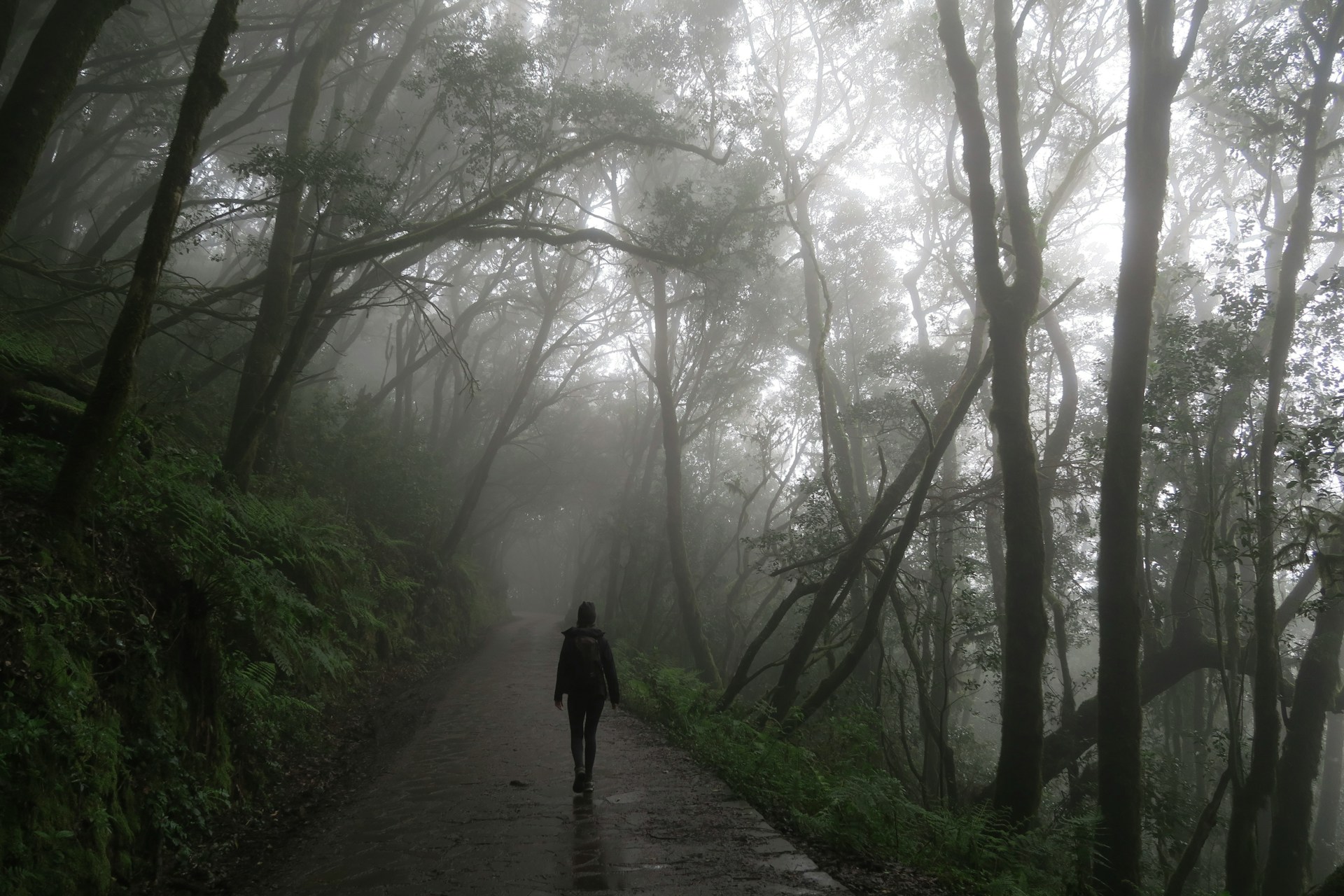
Minutes later, when she’d finally reached the top of the incline, the couple came upon a welcome relief: the trail ahead was flat, with dense tree cover to protect them from the pounding rain.
“Come on,” said Rick. “It’ll be dark soon.”
#
A damp log smoldered over hot coals. The rain had finally let up, and against all odds Rick managed to light a small fire using pine resin clumps he’d brought from home. The forest around them was in that dusky in-between state, where the dying light turns an eerie blue and the animals start to come out. Not quite night, but no longer day.
Rick was drinking tea. His salt-and-pepper hair was styled into an amusing bouffant by sweat and grime. Ellen realized she probably looked no better—she could smell herself beneath all the high-tech moisture-wicking clothing she’d purchased for the trip. Backpacking was new for them, but they didn’t take this trip for fun.
Things at home were rough. Rick had lost his job two months earlier, and his depression was eroding them both, little by little. Arguments were common. Hostility was in the air. And eventually a “relationship reset” was discussed—something new, fresh, and outside their normal routine. A joint venture, meant to bring them together as a team. Backpacking was Ellen’s idea. Just the two of them, away from distractions, hiking in nature. Maybe they’d come back stronger.
The woods in this part of the country were known for being dark and quiet. They boasted thousands of square miles of endless fir and pine masking notoriously difficult terrain. But despite these grim qualities, they received many visitors—well-worn trails snaked between established camp sites one could find on any popular hiking map.
Of course, most hikers tackle this forest in mid-summer, when the weather is friendly. But Rick and Ellen were braving it in April—the height of the rainy season.
Ellen lamented their rookie mistake as she prepared a pouch of dehydrated mac and cheese on a Jetboil stove. They ate it in silence, firelight casting strange shadows across their faces and into the darkening woods.
“My calves are killing me,” said Ellen, blowing steam from a spoonful of neon-orange pasta.
“Mm,” replied Rick, half-present. He seemed lost in thought again; his mood was the heaviest baggage he’d brought.
Ellen let it go. She knew better than to push.
Ageless trees creaked and groaned around them, drops of water falling from their canopies like the tears of some invisible God. The air was still and crisp, washed clean by the rain.
For nearly an hour they did not speak. Part of it was exhaustion. But the subtext was the lingering friction they’d brought from home. Ellen had hoped they would spend this trip reconnecting and talking through their issues, something she felt would heal them. But Rick was quieter than ever. Something was really agitating him, she thought. She wondered if it was her.
But when Rick finally broke his silence, it was something else entirely.
“We’re in danger, Ellen.”
He was looking beyond the campfire into the blackness of the forest.
Ellen felt her skin prickle.
“What? Why do you say that?”
“Because I can feel something I haven’t felt in a long time. Since I was a kid.”
Rick poked at the embers with a stick he’d found. “I realize that doesn’t make much sense to you. Of course it doesn’t. Because I never told you.” He bounced the stick in his hands a few times, like he was weighing its potential as a weapon. “I’ve never told anyone about them.”
Ellen squinted into the darkness around their tiny ring of firelight. She couldn’t see anything—or anyone—out of the ordinary.
“What are you talking about, Rick? Who are they?”
“Them,” Rick corrected her. “Just ‘them’. There is no word for what they are.”
Ellen shifted on the rock she was sitting on. She’d never heard her husband talk like this before.
“They used to watch me when I was a kid. Always when I was alone. They’d peer in my window at night or hide in the shadows of my neighbor’s garden. They leered at me from trees and watched from behind rocks when I played in the woods. I can still remember their smell—like ozone or something. Burned metal.”
Rick’s voice cracked. Ellen noticed his knuckles whitened around the stick he was holding.
“I used to feel nauseous when they were nearby. I hated that fucking smell.”
“Rick…” said Ellen, reaching out to touch him. “It’s been a long day—”
“You don’t understand,” he whispered. “I think they’ve come to take me. I was stupid to think they’d ever go away. They’ve only been waiting.”
Ellen tried to comprehend this sudden change in her husband’s personality. Was he hallucinating? Had he breathed in some psychotropic spore, or eaten the wrong berry somewhere along the trail? “Okay,” she said, trying to remain calm. “What makes you think they’re here now?”
“Because I smell them. It hit me just before we got to camp. The same smell from when I was a kid. They’re near us, Ellen, somewhere out there. There’s nothing we can do.”
Maybe it was the woods, thought Ellen. Maybe it was the stress of losing his job, or the friction in their marriage. Whatever it was, something had opened a crack in Rick’s psyche. He was clearly losing his grip on reality. Imaginary menace aside, she understood they were in real danger now. They were two days hike from civilization and one of them was experiencing a psychotic episode. It was not a good situation.
The campfire spat steam as raindrops began to fall again. The storm was returning.
“Come on, Rick. We’d better get in the tent.”
Rick poked the struggling fire with his stick.
“It’s not going to make a difference.”
#
They lay in uneasy silence for hours, listening to the rain. Their clothes smelled of woodsmoke and grime. Dirt was in the tent and under their fingernails and in their hair. But exhaustion eventually took over, and they drifted to sleep.
#
Ellen woke to an eerie silence. The storm had subsided, and the cool gray light suggested it was dawn. She rolled to her side and saw that Rick’s sleeping bag was empty—it had been unzipped and bunched into a corner. He must be outside, she thought. Maybe boiling some water for coffee. She pulled on her knit beanie, opened the tent, and stuffed her wool-socked feet into a pair of muddy boots.
But when she opened the rain fly and emerged into the misty cold, her husband was nowhere to be seen.
“Rick?”
She was answered only by the silence of the woods. Looking around the campsite, Ellen noticed the tarp over their backpacks was still intact. They had situated it that way to protect their gear from the storm. She walked over and peeled it back.
Both bags were still there. She looked around, puzzled.
“Rick?” she raised her voice.
No response.
He’d be back. He had to be back. There was simply no other option. These woods were inhospitable without warm clothing, food, and fresh water. Not to mention the maps and compasses, the flashlights. All of which were still in the bags. There was no way Rick would go anywhere without those things. Or without her.
Ellen made coffee and a packet of instant oatmeal. There was little else to do but go about her routine as if her husband would return at any moment.
Which, of course, he had to. He must.
#
But he didn’t. And after a few hours of cleaning her gear and breaking down camp, Ellen ran out of things to do and began descending into panic. It was then that she landed on an idea she couldn’t believe hadn’t occurred to her sooner: she would look for his boot prints. Surely if Rick had left camp, there would be a trail in the mud.
This idea only led to more mystery. The campsite was filled with boot prints in the wet earth—circling, overlapping, doubling back on themselves. It was hard to get a read on anything definitive, but eventually she discovered a set of large prints leading off toward the woods, on a trajectory that would have taken Rick off the trail into the nothingness of the expansive forest. Had he lost his mind in the middle of the night and run into the trees? Or—and she tried to push this from her mind—could he have been telling the truth about “them”, the invisible watchers whose presence he claimed to feel the previous night? He had seemed so afraid, so earnestly terrified…
The longer Ellen stayed at the campsite, the more uneasy she became. She had the distinct impression that somewhere, somehow, an invisible set of walls were closing in on her, and the longer she stayed, the more quickly they would converge. When the anxiety finally became unbearable, she made a difficult decision: she tore a waterproof page from a field notebook and wrote a letter to her husband.
#
Rick,
I left this camp at 1 pm on 4/12. I don’t know where you went, and I have no way to find you without getting lost myself. I am going to hike back to the car and get help. I’m leaving your pack here in case you return, along with some food. I’m taking the main tent and leaving you the tarp should you need shelter. Please find me and catch up as soon as possible.
Love,
E.
#
She weighted the note on his backpack with a rock and began walking down the trail they’d come in by the previous night. Her feet struggled to find purchase on the mud-slicked declines, her legs like jelly, every moment a flirtation with an ankle roll or fall. But she managed to stay upright, using her hands when necessary to support herself. The forest was cold, and a thick mist hung between the black tree trunks like a blanket of wispy cotton. Ellen could feel the leaves of dew-soaked ferns brushing her legs like the caress of fingers beckoning her to stay.
After two hours of hiking, she sat on a rock and ate an energy bar. She studied the map, searching for the first night’s campsite. But as she examined the route of the trail, she felt that it was not at all like the one she’d just been walking. Somehow the turns felt backward, or upside down.
It was the mist, she thought. Or maybe the rain had washed away critical turning points on the path, sending her off track. Whatever the cause, Ellen instinctively understood that she was not where she intended to be.
She stood up and walked the trail a few yards in either direction, trying to figure out which way to go. A sickening realization took hold: this was no official route on any map. What had seemed to be a manmade path was just some sort of game trail. She forced herself to stay calm, to think it through logically. If she’d wandered off course, how long ago had it happened?
She had no idea.
Ellen knew there was only one thing to do, and that was head back the way she’d come, or she would only become more lost than she already was. She turned back uphill, following as best she could the route she believed she’d taken that morning, using visual landmarks to stay on track.
It was hard going. The cloying mist obscured her vision beyond a few yards, and the eerie quiet brought a primal unease into every labored breath. Eventually, she found what seemed to be the proper trail, which forked in several directions. Using her compass, Ellen made her best guess which path would lead her back to the safety of her car and the human world beyond.
#
Ellen hiked for several more hours, stopping occasionally to collect fresh water or eat. She could feel her leg muscles spasming, and a dull, throbbing pain plagued her back and shoulders.
But the real torment was psychological. As the sun began to set, Ellen realized she was not close enough to the car to push through with the daylight that remained. If she was reading the map correctly (which she wasn’t entirely sure of), it was still several hours hike away. The idea of hiking this forest in the dark was deeply unsettling to her. It was also downright dangerous: she’d almost slipped and hurt herself several times when she could see where she was going. Attempting the same feat at night was simply out of the question.
With these facts in mind, Ellen prepared for the reality that she’d have to spend a night alone in the woods. Eager to rest, she found a place to make camp, and as she unpacked her bag and began assembling the tent, thoughts of Rick returned. She was many miles from where she’d left his backpack with the note. Had he found it yet? Was he okay? The physical demands of the day had allowed her to put her anxiety aside and focus on the task of escaping the wilderness. But now that she was making camp again—tired, alone, with only her thoughts for company—she began to feel afraid.
Her campfire was small that night. She couldn’t bring herself to sit beside it long, because no matter where she sat, the unnerving sensation of a presence behind her was too much to bear. And as the darkness pressed in tightly around her, it only became worse. Unable to extinguish this creeping dread, Ellen retired to her tent early. In the morning, she would double-time it to the car.
#
The tent flap ripped open like a buzz saw—fast, violent, and wholly unexpected. Ellen gasped, waking from a dead sleep. She scrambled into the corner of the tent, fumbling for her headlamp in the dark. A cold rush of air crashed into the tent alongside a lumpy black shape, grunting in a low register.
Cornered, Ellen gathered her courage and turned on the light.
Crouched inside the tent, flap hanging open behind him, was Rick.
He looked pale. His hair was slicked to his face with rain, and his eyes were wild, like they’d been frozen in witness of some unspeakable horror. He stared into the light of Ellen’s headlamp, sucking in quick, shallow breaths. He was shivering.
“Rick?”
His soiled clothing was torn in several places. Nettles, twigs, and leaves stuck to his damp sweater, and clung in his hair. Ellen put her headlamp on the ground, beam pointing up between them like a lantern. Her heart was pounding.
“Where the hell have you been?”
“Ellen, listen to me,” he said, swallowing a dry lump in his throat as he struggled to catch his breath. “You need to leave as soon as the sun comes up. Don’t wait around, okay?”
“What are you talking about? You’re coming with me, Rick. Here, get in the sleeping bag, you must be freezing!”
But Rick pushed the bag away.
“Listen to me: you’re not going to see me again. Ever. No matter what happens, remember I said that, okay?”
“What the hell are you talking about?”
But Rick was frozen in place. He stuck his nose in the air, quietly turning his head as if trying to hear something far away. After a moment he looked back at Ellen, took her hands, and kissed them.
“I’m sorry. I love you.”
Before she could respond, Rick scrambled out into the darkness, and the last thing she heard was the frantic thumping of his boots as they faded into the woods. Her breath puffed in the beam of her headlamp as she sat in stunned silence, considering what to do. After several minutes of agonizing indecision, she zipped the tent shut, clicked off her lamp, and pulled the sleeping bag around her head.
#
The rain returned, and Ellen lay in her sleeping bag, unable to fall asleep. Her mind raced for what seemed like hours. Exhaustion was pulling apart the strands of her sanity. She prayed for morning. And then she noticed a strange smell.
It appeared slowly at first. Hidden underneath the scent of dirty clothes and wet earth. Lingering on the outskirts of her perception. But then it grew, swelling, stinking, until it overpowered her. It was the scent of an electric spark. A tingling, sterile smell.
Ozone.
Ellen’s nose burned. She closed her eyes and pulled as much of her sleeping bag over her head as she could.
“Please be morning, please be morning,” she whispered to herself.
She heard footsteps. Heavy, slow, scraping through wet leaves. They circled, shuffling, stopping occasionally as if waiting for her to react.
Or toying with her.
Something heavy slapped the tent wall, shaking the whole structure. Ellen bit her fist, holding in a scream. It slapped the canopy a second time, nearly collapsing the whole tent around her. Ellen clenched her eyes shut, tears welling. Blood from her fist trickled between her teeth. She shook uncontrollably, struggling to stay quiet.
But the noises stopped after that. Whatever was out there didn’t try to enter the tent and bothered her no more. Ellen didn’t hear it leave, but after a while, the strange smell was gone, and the air returned to normal. Several hours passed, time bleeding into itself and becoming unrecognizable as she lay in an exhausted hell between wake and sleep.
#
When the light of dawn at last appeared, Ellen heard something new: a man’s voice, somewhere outside.
“Ellen!”
It was Rick.
“Help me, Ellen!”
He had returned! Ellen sat up in her sleeping bag, wiping the frigid tears from her cheeks. She reached for the zipper of the tent and began to open it.
“Ellen! Are you here?”
She peeled open the mesh inner flap and leaned out to open the rain fly.
And then she smelled it: that strange scent again.
“Please, Ellen…”
Rick’s voice was somewhere in the woods, maybe thirty yards past the campfire. It was strained, pleading. Ellen summoned her courage and reached for the rain fly. The zipper’s teeth inched apart under the guidance of her trembling fingers.
Click-click-click.
She lay on her belly, peering out through the small opening she’d created in the flap. At first, she saw nothing but faint smoke drifting from the campfire embers. But then, in the tree line beyond, out where the clearing became a labyrinth of gnarled forest, she saw something: a tall, twisted shape moving between the trunks. It looked gaunt, crooked, bent. Unnatural in its movement. It disappeared almost as soon as Ellen saw it, slipping into the darkness like a snake between knotted roots.
It was not Rick.
“Ellen!”, the woods echoed with the call for help.
Ellen withdrew into the tent, closing the flaps behind her. And there she sat, listening to the mad pleadings of her husband’s voice until daylight finally came.
#
Only when the sun was high did Ellen work up the courage to leave the tent. To her relief, the air smelled clean again. But over where the shadow had skulked that morning, she could see something that made her stomach drop out from beneath her: Rick’s backpack, torn to shreds and hanging in the branches of the trees. His clothing was strewn about the forest floor. She tried to ignore the ghastly tableau, which had no doubt been arranged for her viewing by whatever had been out there the previous night. She decided to leave her tent and sleeping bag behind, remembering Rick’s warning to escape as soon as possible.
Within minutes she was back on the trail, heading west. Her body ached, her knees shook underneath her, and her head was thrumming from stress and lack of sleep. Every fiber of her being wanted to run toward safety, but she understood that to do so would seal her fate. One wrong step, one small injury, and she might lose her ability to leave this place at all. She had to make her escape at a steady pace, terrifying though it was.
Around every bend, behind every rock, and within every thicket she expected to see the tall, loping shape she’d spotted in the trees, whose purpose was unknown but undoubtedly malevolent. Ellen felt her breath working in time with her heart as she thudded down the trail. After a few hours she knew she was getting close, but she didn’t dare stop to check a map. Her previous day’s calculations had shown she had a six-mile hike to the car, and as she felt exhaustion pull her downwards, every step heavier, she wondered how much longer it would be.
“Please, God,” she wheezed in rhythm with her footfalls. “Please, God…”
And that’s when she smelled it again: the faint whiff of hot copper, astringent and sharp.
“No…” she gasped, forcing her body onward in a desperate final push.
The forest grew dark around her. Rain was falling again, the storm returning to continue its punishment. It blew harder and fell heavier until it was nearly as bad as the second night. But Ellen recognized where she was now—the trail head was not far. Minutes away, maybe. She began to see familiar landmarks. Rocks she remembered passing, a babbling creek.
“Ellen! Don’t leave me here!”
A cold shock ran up her spine. It was Rick again, somewhere on the trail behind her. But she dared not look back—instead, she dropped her pack and broke into a pathetic sprint, the kind marathon runners do near the finish line. Broken, stilted, summoning every ounce of remaining strength.
“Ellen… please! Don’t let them take me! Ellen!”
The voice was louder, close behind her and gaining.
“Ellen!”
At last, she rounded a corner and stumbled into the parking lot, where their car—her car—was the only one present. She limped toward it, gravel crunching underfoot, until she got to the door and pulled herself inside. And only then, as she turned the key in the ignition, did she dare look back at the woods.
Hard rain was falling diagonally, the tops of the trees bending in the wind. Her windshield wipers squeaked over dirty glass as the engine rumbled to life.
In the dark of the forest, ghostly lights began to appear—hundreds of them, glowing softly in the trees. They twinkled and winked, hanging like fairies in the blackness.
And as she watched, they grew steadily in number, surrounding the parking lot on every side and expanding into the thousands, winding up into the night sky and shining inside the billowing thunderclouds. Ellen began to weep, striking the steering wheel with an open palm. She screamed into the night until her voice was hoarse.
And as the lights multiplied, she put the car in drive.
#
Sean Cahill is a fiction writer based in California whose recent work has appeared in Defenestration, Unlikely Stories, and Still Here, and The Morgue. His story “Just This Once” is forthcoming in the 2026 print anthology “I Still Haven’t Made It Home” from PWU Press.